
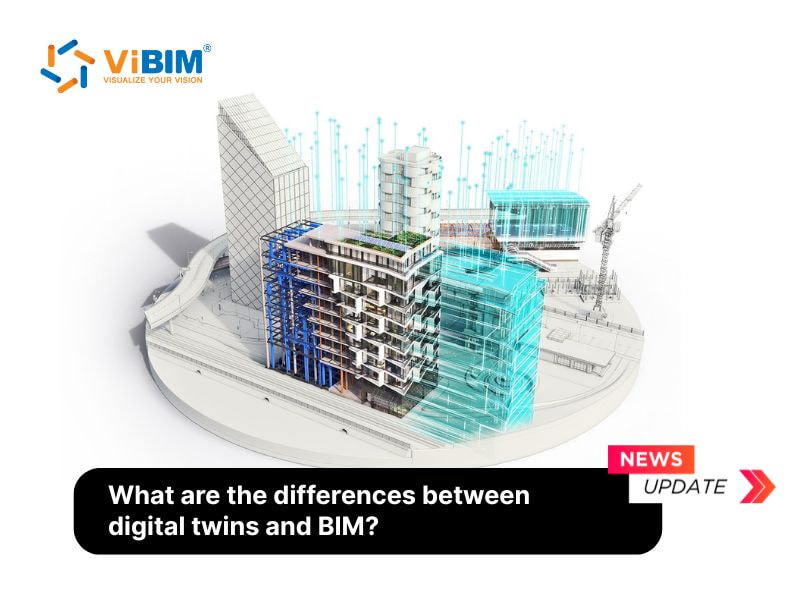
Q: Are digital twins and BIM the same thing?
No. They share a common foundation — both create digital versions of a physical asset — but they answer very different questions. BIM is the process of authoring intelligent 3D models that carry geometry, materials, and discipline-level metadata across the design and construction phases. A digital twin is a live virtual copy of the built asset that pulls continuous data from sensors and operational systems, mirroring real-world conditions during the operations phase. BIM tells you what the building was meant to be. A digital twin tells you what the building is doing right now.
Q: Where does each technology live in the project lifecycle?
BIM dominates the design and construction phases. The 3D model becomes the shared reference that architects, structural engineers, MEP teams, and contractors coordinate around — clash detection, sequencing, fabrication, all anchored to the BIM data. After handover, BIM relevance often declines unless the facility team manually updates the model.
A digital twin starts at handover and runs for the rest of the building's life. It connects the as-built model with sensors, IoT devices, and Building Management Systems to deliver real-time visibility into how the asset is performing. The two technologies are not competing — they are complementary phases of the same data continuum.
Q: What kind of data does each one use?
BIM data is mostly static. It captures the geometry, material specifications, system layouts, and metadata as designed and updated at major milestones (design freeze, construction completion, as-built handover). It is rich, structured, and authoritative — but it represents a snapshot, not a live feed.
A digital twin is dynamic by definition. It ingests real-time data from temperature sensors, energy meters, occupancy counters, HVAC controllers, lift systems, and dozens of other operational data streams. The model updates continuously, sometimes second by second, to reflect actual conditions and behavior.
Q: Can you simulate scenarios with both?
Yes, but the simulation capability is different in kind. BIM supports design-stage simulations: clash detection, structural analysis, lighting studies, basic energy modeling against design-time assumptions. These are valuable for catching issues before construction but they remain tied to static inputs.
A digital twin supports predictive analytics and scenario testing against live data. It can simulate how the HVAC system will respond to a weather event, predict when a chiller is likely to fail based on usage patterns, or test what-if scenarios for energy optimization. The simulation is grounded in actual performance rather than design intent.
Q: How big can each one get?
A BIM model is usually project-scoped — one building, one campus, one defined deliverable. Some firms maintain federated models across multiple buildings for portfolio-wide coordination, but the practical limit is what a project team can author and maintain.
A digital twin can operate at much larger scale. It can represent a single piece of equipment, a building, a campus, an urban district, or an entire city. The scope is determined by the data integration layer, not by what a modeler can author by hand.
Q: What does the integration between BIM and digital twin actually look like?
Five practical steps describe how most teams build this integration in 2026:
-
Design and construction phase — A detailed BIM model is authored in Revit or ArchiCAD with full architectural, structural, and MEP discipline data. Each element carries the metadata that will later anchor sensor mapping and operational analytics.
-
As-built updates — As construction progresses, site changes feed back into the BIM model. Substitutions, relocations, and revisions are captured so the final model reflects what was actually built, not what was originally specified.
-
Handover — The as-built BIM, enriched with warranty information, maintenance schedules, and equipment data, is transferred to the owner. This is the bridge between construction and operations.
-
Operational integration — The BIM model is connected to IoT sensors, Building Management Systems, and other operational platforms. BIM provides the spatial and asset framework; the connected systems provide the live data feed.
-
Digital twin emergence — The static BIM combined with live data and analytics produces a digital twin that continuously reflects building behavior. Facility managers can monitor performance, simulate scenarios, and run predictive maintenance from this single source.
Q: What do teams actually gain from integrating both?
Three measurable outcomes show up consistently:
-
Real-time monitoring and predictive maintenance — Sensor data plus BIM context produces actionable insight into HVAC performance, energy consumption, and equipment health. Maintenance shifts from reactive to predictive, downtime drops, and equipment lifespan extends.
-
Optimized energy and sustainability performance — BIM contributes the physical context (geometry, thermal properties, insulation) while the digital twin contributes real-time environmental and usage data. Together they produce high-fidelity performance simulations that map directly to LEED certification requirements and corporate sustainability goals.
-
Connected lifecycle management — BIM data often dies at construction handover. A digital twin keeps that data alive and useful through operations, renovation, and even decommissioning. Owners retain immediate access to accurate asset history and site conditions without rebuilding institutional knowledge each time a facility manager rotates.
Q: What is the most common mistake teams make?
Treating them as alternatives. Project teams sometimes ask whether they should "do BIM or digital twin." The honest answer is that they are not the same kind of question. BIM is how you build well. A digital twin is how you operate well. Mature AEC organizations treat the BIM model as the foundation that a digital twin is built on, and they architect the handover so that the data continuity is preserved instead of broken.
Q: Does Scan to BIM connect into this?
Heavily. For existing buildings, the digital twin foundation often starts with Scan to BIM. A laser scan captures the existing geometry, the point cloud is processed into a Revit model, and that as-built model becomes the spatial framework the operational sensors plug into. Without a reliable as-built BIM, a digital twin for an existing facility usually does not have the geometric base it needs to be useful.
Q: Where should a team start if they want to combine both?
Start with the BIM workflow you already run, and make the handover deliberate. Most teams already produce BIM models for design and construction; what they do not always do is preserve and enrich those models for operations. A short list of practical first steps: enforce as-built model fidelity at handover, attach equipment data to model elements during commissioning, define the sensor mapping plan before move-in, and connect the BIM model to a single operational data platform before adding more integrations. The digital twin grows from that foundation. Trying to start with sensor data and reverse-engineer the spatial model later is a much harder path.
Reference: https://vibimglobal.com/blog/digital-twin-vs-bim/
See more:
- https://vibim.tumblr.com/post/817390584870371328
- https://vibim.wordpress.com/2026/05/23/digital-twin-vs-bim/
- https://vibim-scan-to-bim.github.io/vibim-syndicate/digital-twin-vs-bim/
- https://vibimscantobim.weebly.com/blog/digital-twin-vs-bim
- https://sites.google.com/vibim.com.vn/vibimglobal/blog/digital-twin-vs-bim
ViBIM
10th Floor, CIT Building, No. 6, Alley 15, Duy Tan Street, Dich Vong Hau Ward, Cau Giay District, Hanoi, Vietnam
(+84) 944.798.298
https://vibimglobal.com/